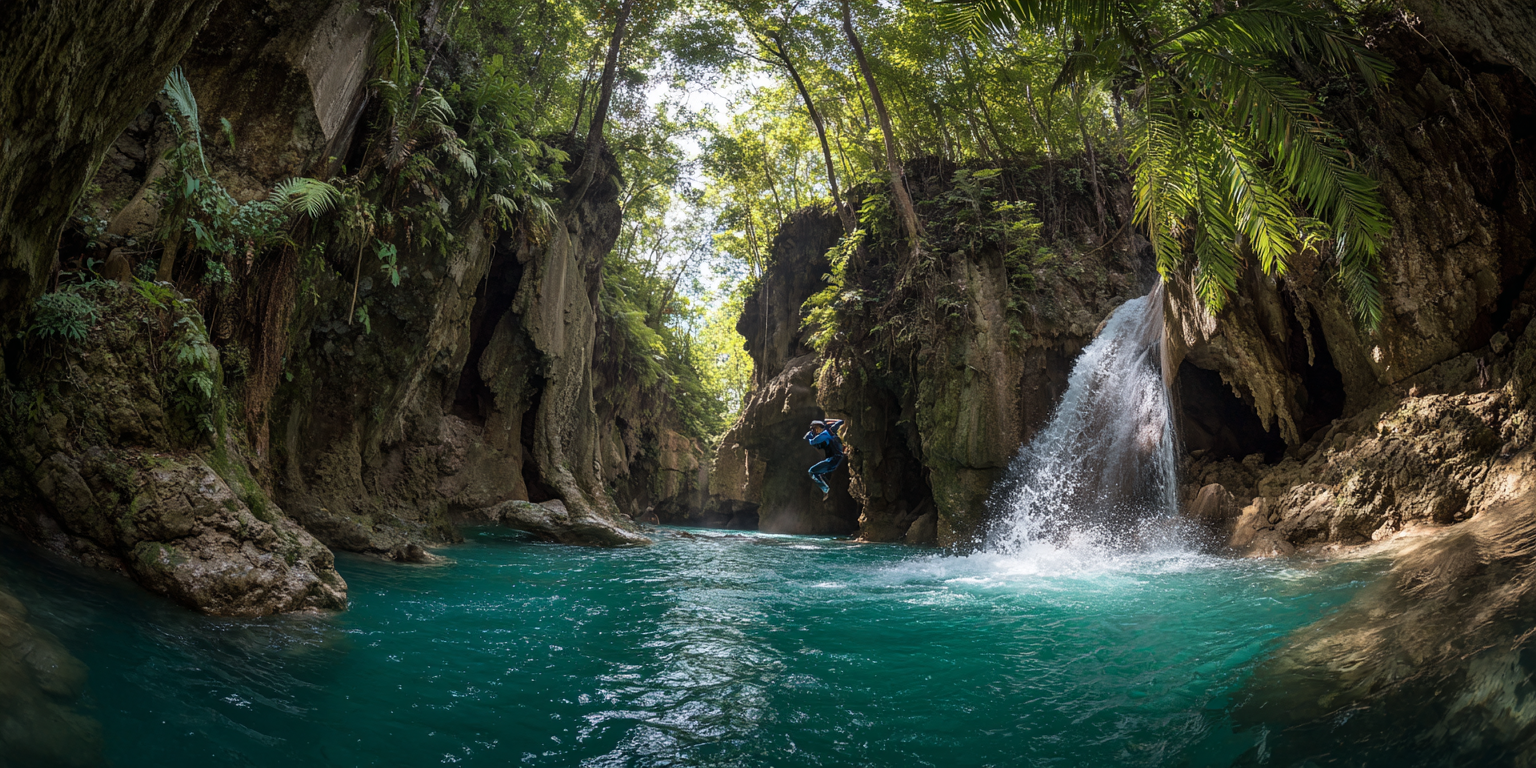

Canyoneering at Kawasan Falls is the single most popular adventure day in Cebu, and for good reason. You jump, slide and swim your way down a limestone canyon in startlingly blue water, finishing at the falls themselves. It is also more demanding and more commercialised than most people expect.
This guide covers what it costs, how hard it actually is, what the safety situation is, and whether the crowds have ruined it.
What Canyoneering at Kawasan Involves
The standard route starts upstream at Kanlaob River in Alegria and works down through the canyon to Kawasan Falls in Badian, on Cebu’s south west coast.
You spend roughly three to four hours in and out of the water. The route mixes swimming through narrow gorges, scrambling over rocks, short rappels or guided climbs down, natural rock slides, and a series of cliff jumps ranging from about 3 metres up to around 12 metres at the biggest.
Every jump has a walk down alternative. Nobody is forced off a cliff, and a good guide will tell you that clearly at the top rather than making you ask.
What It Costs
Packages run roughly 1,500 to 2,500 PHP per person booked locally in Moalboal or Badian, including guide, helmet, life vest, entrance fees and usually lunch.
Booked from Cebu City with transport included, expect around 2,800 to 4,500 PHP. From Moalboal with transfers, roughly 2,000 to 3,000 PHP.
Waterproof bag hire runs about 100 to 200 PHP, and guides will often take photos on a GoPro for an extra 300 to 500 PHP. Confirm whether photos are included before you assume.
The cheapest quotes tend to mean larger groups and less attentive guiding. This is one of those activities where paying the middle price rather than the lowest is worth it.
How Hard Is It Really?
Harder than the marketing suggests, easier than it looks in the videos.
You need to be able to swim confidently in moving water. That is the non negotiable part. Life vests are provided and everyone wears them, but you are still swimming, and there are sections with current.
You need reasonable general fitness. Three to four hours of scrambling over wet rock is tiring, and the exit involves a climb. If you struggle with stairs you will struggle here.
You do not need to be an athlete, and you do not need any technical climbing skill. Plenty of ordinary people in their fifties and sixties do it comfortably.
Minimum ages vary by operator, usually around 8 to 12. Under about 14, expect a guide to steer you away from the bigger jumps entirely.
Safety: the Honest Picture
People have been seriously injured and killed canyoneering at Kawasan. That is worth stating plainly rather than burying.
Almost all incidents come down to three things: jumping without a guide checking the landing zone first, going during or after heavy rain, and unlicensed operators running oversized groups.
The water level changes fast. After upstream rain the canyon becomes genuinely dangerous, and flash flooding is the real hazard. Legitimate operators cancel. If yours is still running a trip while others have stood down, that is not keenness, that is a warning.
What to check: that your guide is accredited with the local tourism office, that helmets and vests are provided and worn, that the group is no more than about eight to a guide, and that someone checks each jump before anyone goes.
Never jump into water a guide has not just checked. Depths shift with the seasons.
When to Go
The dry season, roughly January through May, gives the most reliable conditions and the clearest water.
June to October brings rain, higher water and more cancellations. Trips do run, but be prepared to lose the day and do not book a tight itinerary around it.
Start early regardless. The first trips leave around 7am to 8am and that is when the canyon is quietest and the light is best. Mid morning departures land you in the crowds.
Have the Crowds Ruined It?
Partly, and it depends entirely on timing.
At peak times you can find yourself queueing at the top of jumps behind thirty people, which does undercut the sense of wild adventure considerably. Weekends and Philippine holidays are the worst.
Go on a weekday, on the first departure, outside holiday periods, and it is a different experience. This is the single biggest lever you have.
Kawasan Falls itself, the finish point, is thoroughly commercialised with rafts, stalls and crowds. Manage your expectations: the canyon is the good part, the falls are a busy tourist site.
What to Bring and Wear
Wear quick dry clothing and secure footwear. Sturdy sandals with heel straps or old trainers you do not mind destroying. Flip flops are useless and some operators will refuse you.
A rash guard helps against sun and rock scrapes. Bring a change of dry clothes for afterwards and leave them in the vehicle.
Leave your phone behind unless it is in a proper waterproof case attached to you. Phones are lost on every trip. Leave valuables and jewellery at your accommodation.
Sunscreen before you start, and expect it to wash off. Cash for fees, food and tips in a waterproof bag.
Where to Base Yourself
Moalboal is the usual base and the most convenient, around 45 minutes from the canyon, with the sardine run and Pescador Island to fill the rest of your stay.
Badian is closer still and quieter, with a handful of resorts.
Doing it as a day trip from Cebu City is possible but means a very long day with roughly three hours of driving each way. If you can, stay south for a night or two instead.
See things to do in Moalboal for the surrounding area, and the top things to do in Cebu for the wider island. If you are heading on afterwards, Bantayan Island is the standard next stop north.
Getting to the Canyon
Almost everyone arrives through an operator with transport included, which is the sensible way to do it because the start point at Kanlaob and the finish at Kawasan are different places.
Independently from Cebu City, take a Ceres bus from the South Bus Terminal toward Bato via Barili, around three hours and roughly 150 to 220 PHP, and get off at Badian or Alegria. From Moalboal it is a jeepney or habal habal ride of roughly 45 minutes and 100 to 300 PHP.
Arranging a guide on arrival at Kawasan is possible but you lose the early start, which is the whole game. Book the night before at the latest.
The Fees Broken Down
Packages bundle these, but it helps to know what you are paying for when comparing quotes.
Barangay environmental and entrance fees at the Alegria start point run roughly 50 to 100 PHP. Kawasan Falls entrance at the Badian end is around 60 to 100 PHP. Guide fees are typically 500 to 800 PHP per guide, shared across the group. Helmet, vest and bag hire is roughly 150 to 300 PHP if not included.
Lunch, where included, is usually a simple Filipino buffet at the end. Tips for guides are customary and around 200 to 300 PHP per person is normal for a good trip.
What Else Is Nearby
The south west coast of Cebu packs a lot into a short stretch, and canyoneering pairs naturally with one or two of these.
Moalboal’s sardine run is a short swim from shore at Panagsama Beach and is free if you have a snorkel, which makes it one of the best value things in the Philippines. Pescador Island dive trips run roughly 1,500 to 2,500 PHP.
Oslob’s whale sharks are an hour or so further south and are genuinely controversial on welfare grounds, since the animals are fed to keep them in place. Worth reading up before deciding.
Tumalog Falls near Oslob is quieter than Kawasan and arguably prettier. Badian’s Lambug Beach is the local swimming spot and costs nothing.
Quick FAQ
How much does canyoneering at Kawasan Falls cost? Roughly 1,500 to 2,500 PHP per person booked locally in Moalboal or Badian, including guide, gear, fees and usually lunch. From Cebu City with transport, expect around 2,800 to 4,500 PHP.
Do you need to be able to swim? Yes. Life vests are provided and worn throughout, but you are swimming through moving water for parts of the route, and confident swimming is the one genuine requirement.
How long does canyoneering at Kawasan take? Around three to four hours in the canyon itself, plus transfers. Allow most of a day from Moalboal and a very long day from Cebu City.
Do you have to do the cliff jumps? No. Every jump has a walk down or climb down alternative, including the largest at around 12 metres. A good guide will point this out at the top without being asked.
Is canyoneering at Kawasan safe? It carries real risk and there have been serious accidents. Most trace back to heavy rain, unlicensed operators and jumping before a guide has checked the landing. Use an accredited operator, keep groups small and never go when rain has raised the water.
What is the best time of year to go? January through May in the dry season gives the clearest water and fewest cancellations. Go on a weekday and take the first departure of the day to avoid queueing at the jumps.