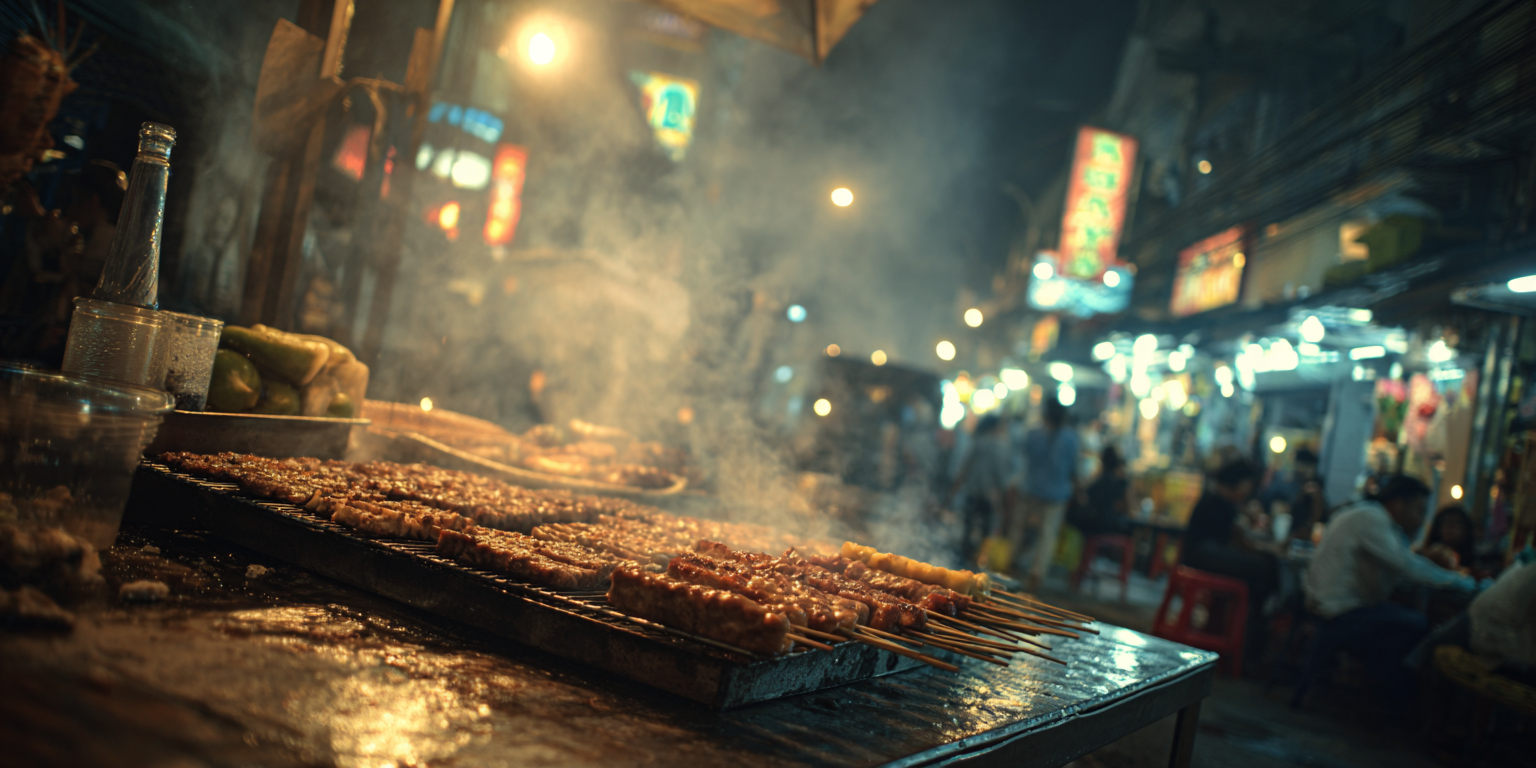

Manila’s best street food does not happen at lunchtime in a food court. It happens after dark, when carts roll out under bare lightbulbs, charcoal grills get lit, and entire streets in Poblacion, Quiapo, Binondo and Divisoria turn into open air kitchens that stay busy well past midnight. If you want to understand how the city actually eats, this is where to look, not the mall food courts that show up first in most guidebooks.
This guide covers the neighborhoods worth heading to, a companion to our broader Top Things to Do in Manila guide,, the dishes worth trying, roughly what they cost, and the practical details, cash, timing, food safety, that make a first night of street food go smoothly instead of overwhelming.
Where to Go: Poblacion, Makati
Each area covered below has its own character, so pick based on how adventurous you want your first night to be.
Poblacion is Makati’s original settlement, now a dense grid of old houses, bars and food carts a short walk from the glass towers of the central business district. It is the most nightlife adjacent of Manila’s street food areas, so expect carts clustered near bars and a crowd that skews toward a mix of locals and expats bar hopping between drinks. It is also the easiest area for a first timer, with reasonably well lit streets and a steady stream of foot traffic most nights of the week.
Where to Go: Quiapo and Binondo
Quiapo, around its namesake church and market, leans heavier and cheaper: fried tofu (tokwa), lumpia, and lugaw (rice porridge) alongside the grilled skewer carts, aimed more at commuters and market workers than tourists. Binondo, the world’s oldest Chinatown, layers Chinese-Filipino fusion dishes into the mix, think fried siopao and noodle dishes alongside the usual grilled offerings, and rewards slow wandering more than a fixed plan. Both areas are busier and more chaotic than Poblacion, with narrower foot traffic and less English spoken at the stalls, which is part of the appeal if you want something less curated.
Where to Go: Divisoria and Tutuban Night Market
Divisoria is Manila’s wholesale shopping district, and its street food scene runs alongside the market stalls rather than as a separate destination. Nearby, Tutuban Night Market sets up after the surrounding malls close, with a reputation for being cleaner and more organized than some of the older street clusters, and vendors here sometimes offer a discount for buying two or three of the same item at once.
Isaw: The Essential Starting Point
Start here before branching into anything more adventurous, since it sets a useful baseline for how these carts operate.
Isaw is grilled skewered intestine, either chicken (thinner, slightly wavy) or pork (larger, chewier), cleaned and boiled before it is marinated and grilled over charcoal. It is the single most common item at any street food cart and a reasonable place to start if you are new to this kind of eating. Two sticks of chicken isaw typically cost around 30 pesos, dipped in a vinegar based sawsawan with onions and chili that most stalls set out communally.
Kwek-Kwek, Tokneneng and Other Fried Snacks
These two are the easiest recommendation for anyone still deciding whether street food is for them.
Kwek-kwek is a hard boiled quail egg coated in bright orange batter and deep fried, sold by the cup, usually four pieces for around 25 pesos, served with a sweet, slightly spicy pink dipping sauce. Tokneneng is the same idea with a regular chicken egg instead of quail. Both are widely considered a safe, approachable entry point alongside isaw, since the ingredients are simple and the frying happens right in front of you.
Balut: What It Is and Whether to Try It
Balut is a fertilized duck egg, boiled and eaten from the shell, and it is the item most foreign visitors have heard of before landing in the Philippines, usually with some apprehension. It has real cultural weight here rather than being a novelty dare, and plenty of Filipinos eat it as a regular late night snack with a pinch of salt or splash of vinegar. Whether to try it is entirely a personal call. If you are curious, buy one from a busy stall rather than a quiet one, and know that a slightly older balut (locally graded by age) has a more developed embryo and a stronger flavor than a younger one.
Pares, Lugaw and Heartier Options
Not every street food stop is a quick skewer. Pares, a rich beef stew served over garlic rice, is a common late night option near isaw carts and fills a different need than a snack, more of a full meal for around 60 to 90 pesos. Lugaw, a savory rice porridge often topped with fried garlic, egg and scallions, is another common option, especially in Quiapo, and works well as something lighter or as a base before or after trying the fried and grilled items.
A Few More Dishes Worth Seeking Out
None of these require advance planning, part of the appeal of this kind of eating is that you can simply follow the crowd and the smell of charcoal to find something worth trying.
Beyond the core lineup, a handful of other stalls are worth tracking down if you have more than one night to explore. Fishballs and squidballs, deep fried and skewered, are sold everywhere for a few pesos each and dipped in a sweet or spicy sauce depending on preference, they are less distinctive than isaw but a reasonable snack between stops. Betamax, grilled coagulated pig or chicken blood cut into small squares, named for its resemblance to old videotape cassettes, is another common grill item for the more adventurous. Turon, a fried banana spring roll usually with a caramelized sugar coating and sometimes jackfruit inside, is the most common dessert option and a good way to close out a night of savory food. Taho, a soft tofu dessert with sago pearls and brown sugar syrup, is more of a daytime and early evening item sold by vendors carrying twin buckets on a shoulder pole, so keep an eye out for it earlier if you are heading out before dark.
What a Night of Street Food Actually Costs
The single biggest appeal of Manila street food is value. For roughly 400 to 500 pesos, you can sample five or six different dishes across two or three stalls, more variety than a single restaurant meal at the same price would give you. A light night of just a few skewers and a cup of kwek-kwek can run well under 200 pesos. Compare that to a sit down restaurant meal in the same neighborhood, which will usually run several times as much for a fraction of the variety.
Weather and Timing Considerations
Manila’s street food scene runs year round, but the experience changes with the season. During the dry months from roughly November through April, evenings are more comfortable for walking between stalls, and the crowds tend to be thicker since more people are out. During the rainy season from June through October, sudden downpours can shut down outdoor carts with little warning, so build in a backup plan, a nearby covered market or mall, if you are visiting during typhoon season. Weekday nights are generally calmer and easier to navigate than Friday and Saturday nights in Poblacion specifically, where the bar crowd adds significantly to the foot traffic.
Food Safety: How to Choose a Stall
The most reliable signal is turnover, not appearance. A busy stall with a line, even a short one, is selling through its stock quickly, which matters more for food safety than how polished the cart looks. Watch whether the vendor handles cash and food with some separation, and check that the communal sauce station looks like it gets refreshed rather than sitting out all night. Millions of Manila residents eat this food daily without issue, and the ordinary precautions that apply to any street food anywhere, busy stall, freshly cooked in front of you, sealed drinks, apply here too.
Guided Food Tours vs Exploring on Your Own
A number of operators run organized night market and street food tours through Poblacion, Quiapo and Binondo, typically bundling several stops with a guide who handles ordering and explains each dish along the way. These make sense for a first night if you would rather not navigate on your own, especially in Quiapo and Binondo where English is less commonly spoken at the stalls themselves. Going it alone costs nothing beyond the food itself and lets you set your own pace, and honestly, once you have the basic vocabulary and a sense of which stalls draw a crowd, it is not a difficult thing to do independently on a second or third night.
Practical Tips: Cash, Timing and a Few Phrases
Bring small denominations. Most vendors cannot break a 1,000 peso bill, so carry a mix of 20, 50 and 100 peso notes before you head out. Most carts set up from around 6 p.m. onward and stay busy well past midnight in the livelier areas. A simple “Magkano po?” (how much?) or “Salamat po” (thank you) goes a long way and is genuinely appreciated by vendors used to dealing mostly with local customers. Buy bottled water from a sealed source rather than an open container, convenience stores are common across all four neighborhoods covered here. If you are with a group, order one or two items per stall and share rather than filling up at the first cart, since the point is sampling widely, not eating a full meal in one stop.
What to Skip and Honest Limitations
Street food at night is not a controlled, sanitized experience, and treating it like one misses the point while also setting up unrealistic expectations. Expect crowded, sometimes narrow foot traffic, especially in Quiapo and Binondo, and expect that not every stall will have English signage or an English speaking vendor. If you have a sensitive stomach or dietary restrictions that are hard to communicate, stick to the simpler fried items like kwek-kwek rather than anything with a sauce or marinade you cannot ask about. And if late night crowds and standing room only eating are not your idea of a good time, a sit down turo-turo (point and eat) carinderia earlier in the evening covers similar dishes in a calmer setting, just with less atmosphere.
Planning the Rest of Your Manila Trip
If street food is one stop on a longer Manila itinerary, see our Manila Travel Guide for broader logistics and our guide to getting from Manila to Baguio if you are continuing north afterward.
Quick FAQ
Is Manila street food safe to eat? Generally yes, if you follow ordinary precautions: pick busy stalls with high turnover, drink sealed bottled water, and use common sense about anything that looks like it has been sitting out.
Where is the best area for street food in Manila? Poblacion in Makati is the easiest starting point for first timers, while Quiapo, Binondo and Divisoria offer a cheaper, less curated experience aimed more at locals.
How much does a night of street food cost? Roughly 400 to 500 pesos covers a genuine sampling of five or six different dishes across a couple of stalls. A lighter night of a few items can cost well under 200 pesos.
What should I try first if I am nervous about street food? Kwek-kwek and tokneneng are the most approachable starting points since the ingredients are simple and you can watch them fry in front of you.
Is balut worth trying? That is a personal call. It carries real cultural weight in the Philippines rather than being a novelty, and plenty of locals eat it as a regular snack, but there is no obligation to try it if it does not appeal to you.
What time do the street food carts open? Most set up from around 6 p.m. and stay busy well past midnight in the livelier areas like Poblacion and Tutuban Night Market.
Still deciding on a base? Our guide to where to stay in Manila compares Makati, BGC, Malate, Intramuros and Pasay, with rough nightly prices for every budget.